RAM, Your Memory
I have a grand memory for forgetting.
– Robert Louis Stevenson, Scottish novelist
Your memory is a limited resource. That is not a flaw; it is simply how the system works. The goal is not to remember everything, but to use memory well.
We live in a world with more available information than any person can hold in their head. That means the challenge is no longer access to information alone, but deciding what deserves space in our memory and what should remain in external systems such as notes, books, files, tools, or documentation.
In that sense, memory works best when we treat it less like a warehouse and more like a smart guide. We do not need to keep every detail available at all times. Often, what matters most is knowing what something means, how it connects to other ideas, and where to find it again when needed.
This chapter is not about memorising more for the sake of memorising more. It is about learning how memory really helps us think, learn, and work better.
How Our Memory Works
People often imagine memory as if it were a storage device: you place something inside, it stays there, and later you retrieve it unchanged. But our experience tells us that memory is not that simple. Some moments stay vivid for years, while others disappear quickly or return in distorted form.
Memory works less like a fixed archive and more like a living network. We remember things better when they connect to other things we already know, when they are repeated, and when they carry emotional, visual, or sensory weight. That is why a face is often easier to remember than a name, and why a story is often easier to retain than a list of isolated facts.
Your current page makes this point well through the “first day at a new job” example. After meeting many people in a single day, most of us remember only a few names, but we often recognise more faces than names later on. That happens because an image usually carries richer and more connected information than a word alone.
This also explains why repetition matters. The page currently introduces the idea of synaptic reinforcement and long-term potentiation as a simple explanation for why repeated exposure and practice make recall easier over time. You do not need deep neuroscience here; the practical lesson is enough: what we revisit and use tends to stay available, and what we neglect tends to fade.
That is why practice works. Musicians repeat passages, athletes repeat movements, and speakers rehearse ideas until the process becomes more natural. Repetition is not glamorous, but it is one of the most reliable ways to strengthen memory.
At the same time, not every piece of information deserves that level of effort. Memory is valuable, so it should be used with intention.
Your Memory Enemies
One of the strongest sections in your current page is the set of “illusions” drawn from The Invisible Gorilla and related ideas. This part works well because it shows that memory problems are not only about forgetting; they are also about false confidence, selective attention, and mistaken interpretation.
Illusion of Attention
When we focus closely on one thing, we often miss what is happening around it. Your page uses the famous gorilla experiment by Christopher Chabris and Daniel Simons1 to illustrate this point. When people concentrate on counting passes in a video, many fail to notice a person in a gorilla suit walking through the scene.
The lesson is simple: attention is selective. When we focus strongly on one target, we can become blind to other important information. In daily work, this happens when we look so hard for one kind of issue that we miss the broader situation.
Illusion of Memory
We tend to trust our memories more than we should. But memory is not a perfect recording. It changes over time, fills gaps, and sometimes blends reality with interpretation.
This helps explain common experiences, such as returning to a place from childhood and feeling that it is much smaller than you remembered. The place may not have changed much; your mental version of it did.
If you tell a lie big enough and keep repeating it, people will eventually come to believe it
Illusion of Confidence
Feeling certain does not guarantee being right. The page currently uses examples such as confident witnesses whose accounts do not fully match the evidence. That is a useful reminder that confidence and accuracy are not the same thing.
A healthy response is intellectual humility. We can have strong views while still remaining open to correction, evidence, and alternative explanations.
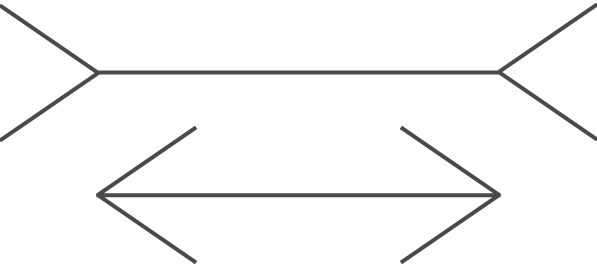
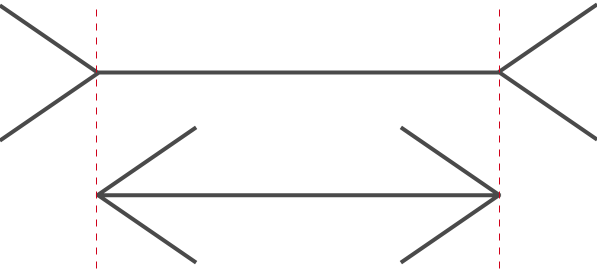
Look at the picture representing a Müller-Lyer illusion. You might have seen it before, but even though you know that both lines are the same length, your eyes keep telling you that the top line is longer than the bottom line. In a nutshell, this effect is what the illusion of confidence produces. Your senses and perceptions provide you with some information that you want to follow, but that doesn’t match reality.
Illusion of Knowledge
Sometimes experience makes us more capable. Sometimes it also makes us overconfident. When we know a subject reasonably well, it becomes easier to assume we understand more than we actually do.
That is why a good professional is not only skilled, but also careful. In situations of doubt, it is often better to admit uncertainty, verify the facts, and learn what is missing than to improvise beyond our understanding.
Illusion of Cause
Human beings are excellent pattern seekers. That helps us learn quickly, but it also makes us vulnerable to false explanations. We often see causes where there are only coincidences, habits, or incomplete stories.
Your current page is right to recommend more disciplined thinking here. When the stakes matter, we should look for evidence, not just for the most familiar explanation.
Illusion of Potential
The page also challenges the idea that unlimited effort automatically produces unlimited potential. That is a useful correction. Practice matters, but people also differ in interests, abilities, context, and limits.
Recognising limitations is not defeatist. It is practical. It helps us choose better, collaborate more, and invest our effort where it has the greatest return.
Enjoy the process
One of the most human parts of your current page is the reflection on songs, school learning, prayers, and playful experiences with children. The underlying insight is strong: we remember better when learning feels engaging, patterned, emotional, or enjoyable.
This does not mean everything has to become entertainment. It means the way we package information matters. Rhythm, repetition, images, stories, and small moments of enjoyment can make knowledge easier to absorb and easier to retain.
That is why preparation matters. A good learning process removes unnecessary friction, reduces avoidable obstacles, and makes the path easier to follow. The more welcoming the process feels, the more likely we are to stay with it long enough to learn.
Select What to Add
Not everything deserves a place in memory. This may be one of the most practical ideas in the chapter.
If information is well documented, easy to retrieve, and rarely needed, it often makes more sense to keep it in an external system than to force it into memory. Notes, manuals, checklists, reference pages, templates, and documentation all serve as extensions of our mental capacity.
Your current page gives technical examples such as APIs, specifications, setup procedures, and configuration steps. For a broader audience, the same principle applies to forms, policies, travel procedures, account details, presentation templates, administrative workflows, and any process that can be referenced reliably instead of memorised.
A simple rule is this: do not spend heavy mental effort memorising what is easy to look up and rarely used. Save memory for what helps you think, decide, communicate, create, and act faster in meaningful situations.
Method of Loci
The Method of Loci is one of the strongest practical tools on the page. Your article describes it as an ancient memory technique, also called the Memory Palace, in which we connect information to a familiar place and recall it by mentally walking through that place.
The method works because it combines several strengths of human memory already discussed in this chapter:
- Connection to what we already know.
- Use of place and sequence.
- Use of vivid or unusual images.
- Use of story rather than isolated data.
This method is very ancient, dating back to Ancient Greece. The first description of this method is from Saint Augustine in his Confessions, where he likens it to a warehouse where one stores memories. It is also called the Memory Palace, Memory Journey, or Mind Palace.
The Eight-time World Memory Champion Dominique O’Brien popularized it. He uses this method, among others, to memorize two unsorted decks of cards just by seeing them once, and then he can tell which cards are in sequence.
The American Physiological Society published a study2 about this methodology. For this study, the APS identified 28 students from diverse areas. Among other results, the study showed that most students, 92.9%, could recall facts better after learning them with the Method of Loci.
However, the most impressive aspect of this method is how easily it can be learned, applied, and benefited from.
Before humans developed the ability to write, they transferred information from generation to generation. It happened when, in middle age, illiteracy was widespread. And people did it by telling stories. Stories, such as tales or songs, are easy to understand and remember. Our brain is good at remembering stories because we create relations and use our imagination to strengthen those synapses.
In essence, the method of loci consists of linking a place you know very well with the information you need to remember. The basis of it is two principles:
- Connection Principle - It is much easier to keep something in memory when you connect elements you already know with concepts you are trying to learn.
- Von Restorff Effect - Also known as the isolation effect, it states that among multiple homogeneous stimuli presented, the stimulus that differs from the rest is more likely to be remembered.
These two principles suggest that you utilize what you know and imagine unusual things to refine your mind’s concepts. In some way, you are talking with your brain in its language.
The place
All stories happen in a specific place. Choose a place that is already familiar to you. It could be a room, your home, a route you walk often, your office, or any other setting you know easily and clearly.
The chronological order
Define a clear path through that place. The order matters because it becomes the structure that holds the information together.
The characters and objects
Now attach the information you want to remember to memorable images along that path. The stranger, funnier, or more exaggerated the scenes are, the easier they usually are to remember. That is one reason the method works so well.
If a concept is abstract, translate it into a visible object, a character, or an action. If a word is hard to picture, break it down into something simpler or more personal.
The key is to imagine the scene with detail. The richer the image, the stronger the mental hook.
The most crucial concept in this method is to imagine all the story elements with as much detail as possible. Your imagination is one of the most powerful tools you have.
As always, the best way to learn is by example, so let’s apply the method by preparing a speech.
Example
Imagine that you need to deliver a talk next week. The biggest fear is forgetting any of the topics you need to discuss. So we’ll apply the method here.
- At the entrance, imagine a truck bursting through the door to represent entering the market.
- In the next position, imagine a giraffe with an impossibly long neck to represent growth.
- Then picture a monkey hanging from the ceiling to represent unresolved issues.
- Place a bright projector further along the path to represent future focus.
- Use the front row of seats to represent market position.
- End with a red carpet and applause to represent gratitude and thanks.
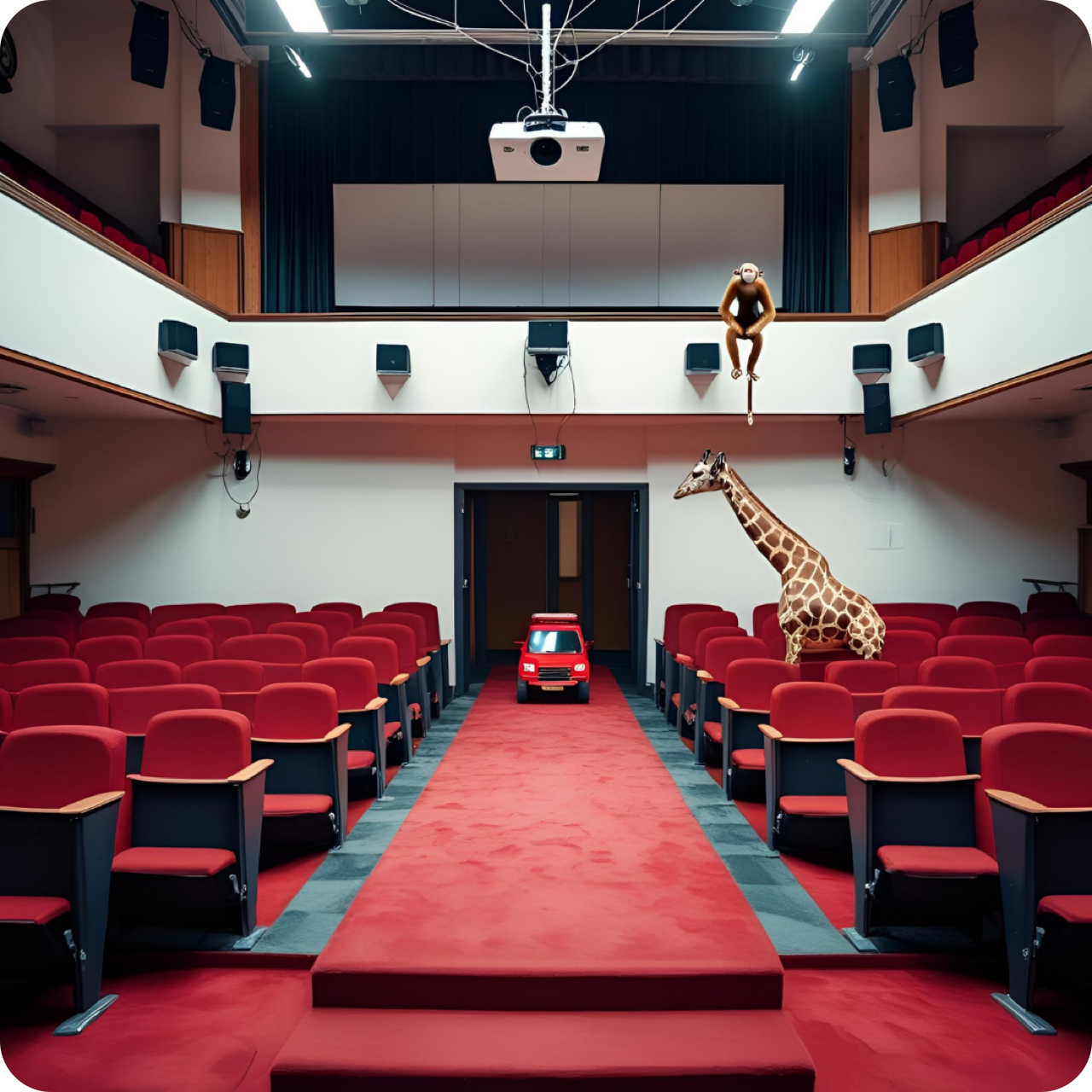
Now let’s create a path to move from one element to the other, for example this one.
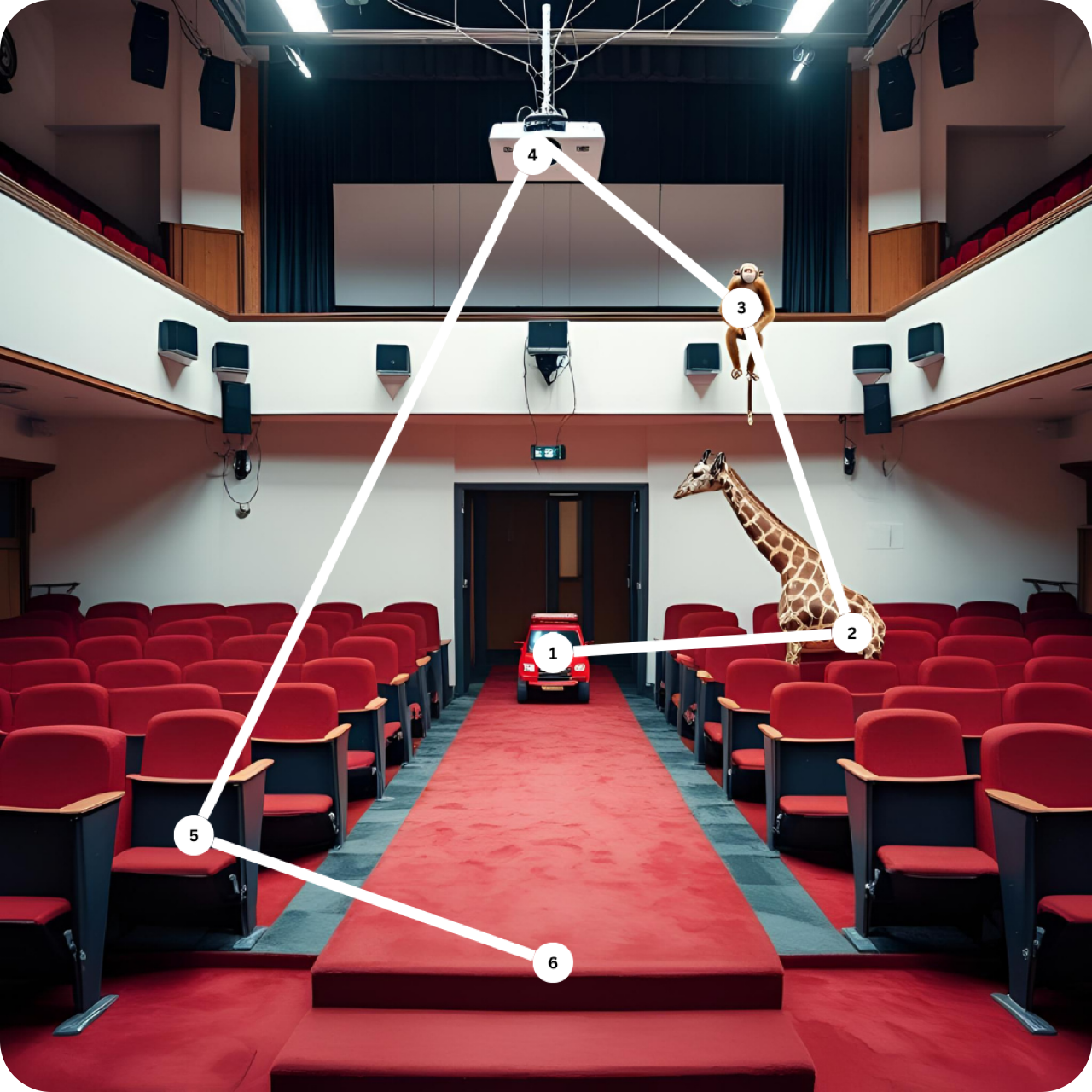
With all elements in place, we can create a tale to remember all the topics.
Now create a scenario with a list of people you need to thank for their efforts. To do this, find an alternative location and associate each person with a step on the path.
Key ideas
Your memory is limited, so it should be used intentionally.
We remember better through connection, repetition, and meaningful context than through brute-force storage.
Attention is selective, so focusing on one thing can make us miss another.
Memory is not a perfect record of reality.
Confidence does not guarantee accuracy.
Intellectual humility protects us from false certainty.
Not everything deserves to be memorised; external systems are part of working well.
Learning becomes easier when the process is structured, engaging, and repeated over time.
Techniques such as the Method of Loci help us work with the strengths of memory instead of against them.