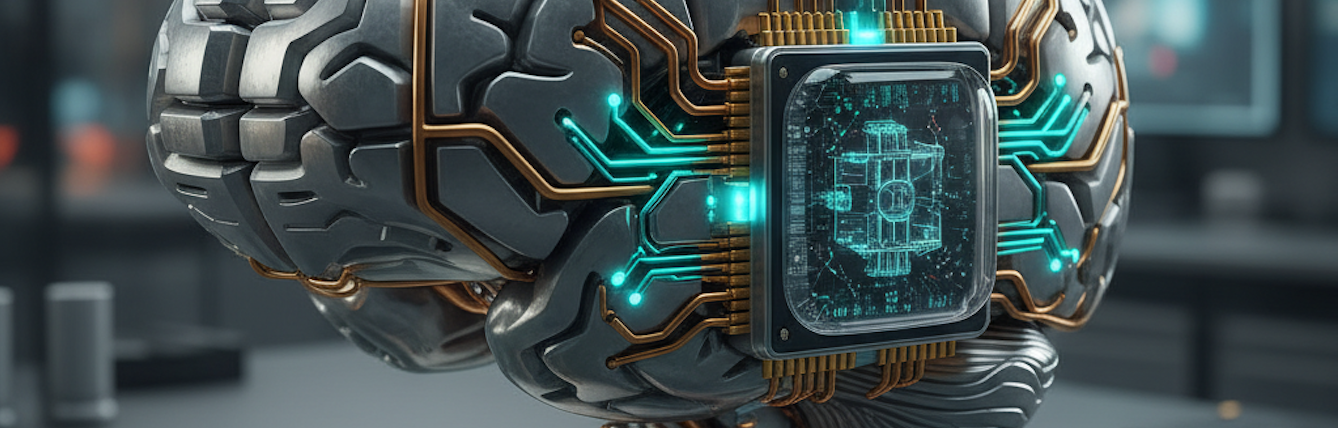
CPU
Your brain is the most advanced CPU known to humankind; you need to understand how to harness its maximum power.
TIP
In terms of the brain, you can, in a crude way, think of the human brain as a computer.
–Paul Greengard, American neuroscientist
Thanks to movies like “2001: A Space Oddity”, “The Matrix”, or “I, Robot”, our collective imagination has created the concept of a processor that resembles the human brain. In reality, and terms of evolution and comparison, a processor is closer to an abacus than it is to the brain of a chicken. The reason for that is that we never designed the processors to be the brain of the beast; we created them as an advanced “calculator” that can perform extraordinarily complex operations in no time.
The fact that the combination of fast hardware and elaborate software can simulate human behavior is astonishing. However, the key point here is “simulate”. We cannot expect to have a set of instructions in our brains that can parallel the software used in tandem processors, as found in computers. Instead, we have the synopsis, which is an entirely different approximation. During this book, you will read a good number of analogies between the world of computers and our bodies. The goal of these analogies is to make it easy to understand what aspect we are about to discuss, not to suggest that we are some biological computer.
The basics of this section are understanding that we don’t have a processor in our brain, and more than that, we shouldn’t because we have something better, we have the result of millions of years of evolution to create the most fantastic problem-fixing machine.
When Allan Touring was creating the first generic problem-solving machine, he was fully aware that the goal was to leverage what machines were good at, to perform repetitive jobs based on a set of simple instructions much faster than a human could. The goal of Booster 🚀 Skills is to leverage what humans are good at.
In the following chapters of this part, we will explore the equivalent parts of our brain that function like a processor and how to make them more efficient.
Task manager
We have a task manager, just like a processor. In the same way, a processor executes one task after another; similarly, we have our daily tasks, and we can optimize how we perform, sort, and discard them to deliver results. We will learn how to structure our tasks and manage them to maximize our productivity with minimal effort. In essence, not just about doing more, but also about doing what’s more profitable and helps us increase the value of what we spend our time on.
RAM
We need temporary memory to store information, much like RAM. Instead of using it simply as a temporary repository, we can make much more with it. We excel at creating associations and generating new content, but struggle with storing and retrieving atomic content later. We’ll discover how to enhance our abilities and mitigate our weaknesses by utilizing our instant memory for its intended purpose, resulting in more efficient usage, less wasted storage, and lower power requirements to work at its maximum capacity.
Process organization
One of the most critical aspects of facing our daily work is determining where to start, what to do, what is more important, and what we can delegate. These sorts of questions appear when you need to plan your day, week, month, or even the year. Preparation and filtering will help to focus on what is necessary and get the most out of our effort. Defining reasonable procedures and executing tasks most efficiently empowers our capacity while freeing up more resources to use where required.
Loading new content
We can add new “apps” to our system to learn new skills, not a la Matrix, but we have a different kind of App Store. Learning is something we are born with, but as time passes, it becomes increasingly complex to acquire new skills. We’ll learn how to make it easier to acquire new knowledge and skills, allowing us to improve the process. A crucial aspect of this is to select what to learn and what to disregard. Not all learnings have the same importance during our lives, and not all learning requires the same level of expertise from us.